Security
-
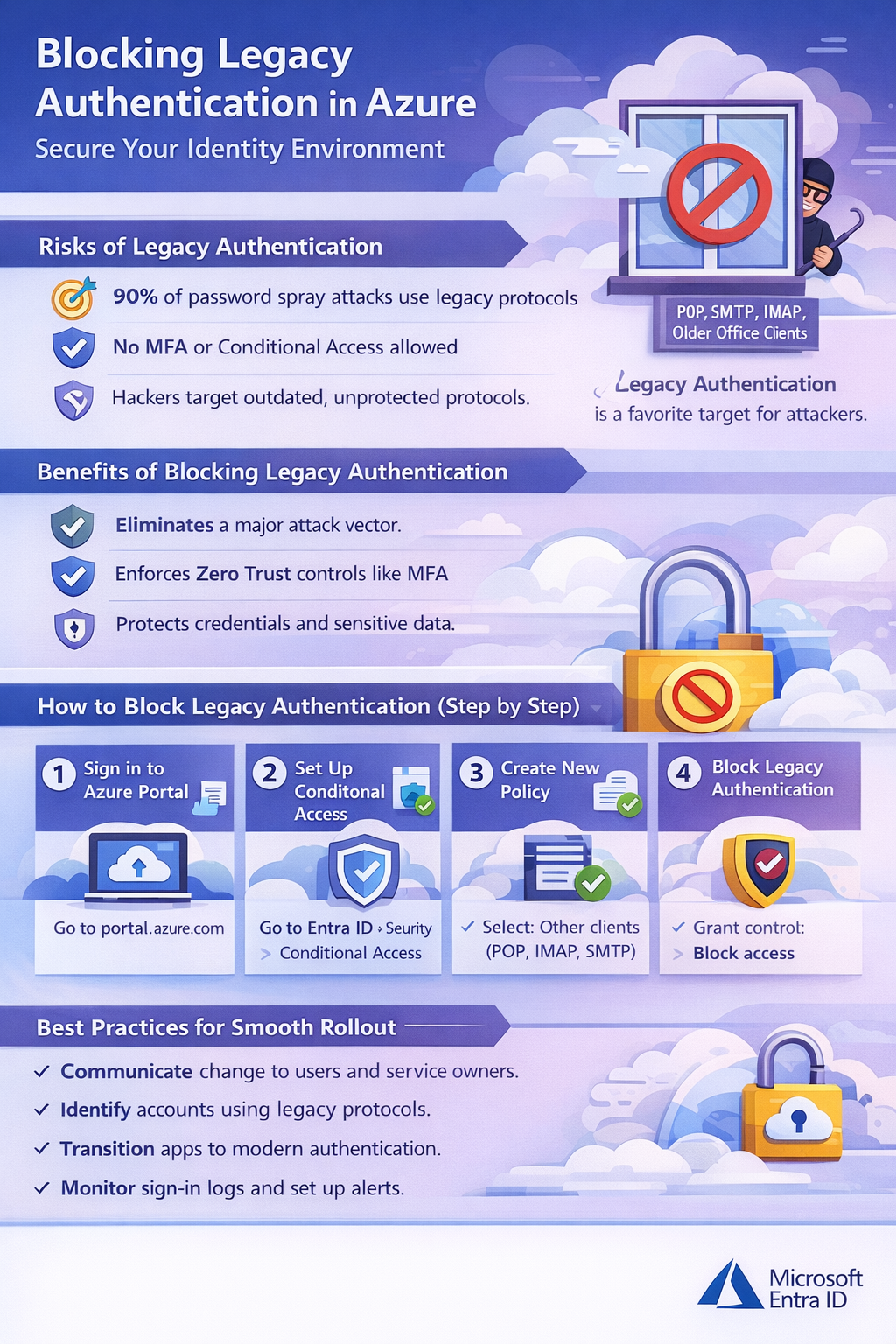
The Hidden Risk of Legacy Authentication
You will often hear about identity breaches, password sprays, and phishing attacks — and yet, the most overlooked attack vector remains legacy authentication. Protocols like POP, IMAP, SMTP, and older Office clients were designed decades ago, long before modern identity threats existed. They cannot enforce Multi-Factor Authentication (MFA) or Conditional Access, making them a persistent…
-

Why Multi-Factor Authentication is Non-Negotiable for Azure Security
You will never out-patch, out-educate, or out-monitor credential theft — but you can neutralize it. Multi-Factor Authentication (MFA) is the single most effective control available to stop account compromise, making it a foundational pillar of Zero Trust and modern cloud security. When MFA is enforced consistently, stolen passwords become largely useless, dramatically reducing the risk…
-

Azure Logic Apps: Automating Workflows for Security and Business Efficiency
Learn how to use Azure Logic Apps with Microsoft Sentinel to automate workflows, enhance security, and streamline business processes. Step-by-step guide with best practices from Microsoft Cloud Security Framework. Automation is no longer optional—it’s essential for modern businesses and security operations. By combining Azure Logic Apps with Microsoft Sentinel, organizations can streamline incident response, strengthen…
-

Advanced Threat Intelligence & Hunting with Microsoft Defender and Sentinel
Threat intelligence shouldn’t live in spreadsheets. It should live in your detections. Microsoft Sentinel’s integration with Microsoft Defender Threat Intelligence enables security teams to move beyond reactive alerts and into intelligence-led threat hunting. By correlating high-fidelity Microsoft-curated indicators with real telemetry—endpoint, identity, and network data—you can surface adversary activity earlier and with higher confidence. In…
-

Using Microsoft Defender Threat Intelligence in Sentinel for Advanced Threat Detection
It’s a special Christmas AzureTracks article this year! Cyber threats don’t take holidays—but your SOC can with the right tools. Discover how Defender Threat Intelligence + Sentinel helps identify emerging and persistent threats with real-time IoCs and AI-powered analytics. Will you find who ate Santa’s cookies and catch the Christmas culprit?
-

Future-Ready SOCs: Microsoft Sentinel Data Lake Powers AI-Driven Security
As 2025 wraps up, Microsoft Sentinel takes center stage with a major innovation announced at Ignite: Sentinel Data Lake. This feature is designed to unify security signals, reduce SIEM costs, and enable AI-powered threat detection at scale. In this article, we’ll explore what Sentinel Data Lake means for SOC operations, why it matters, and how…
-

Responding to Ransomware with Azure’s Security Tools
Best practices for defending against ransomware with Microsoft’s security capabilities Ransomware isn’t just malware—it’s a breach. And in today’s threat landscape, it’s often human-operated, coordinated, and devastating. Microsoft Azure offers a layered defense strategy that combines proactive detection, rapid response, and resilient recovery. This article explores how to leverage Azure’s native security tools to build…
-

Microsoft Ignite 2025: Compute, Security, Architecture & AzureTracks Highlights
Microsoft Ignite 2025 delivered transformative updates across cloud computing, security, and architectural best practices. This year’s announcements emphasize AI-driven optimization, zero-trust security, and hybrid cloud strategies, alongside AzureTracks, a structured learning initiative for cloud professionals. An incredible week for Microsoft Cloud yet again this year!
-

Effective Management of Identity and Access with Microsoft Entra ID
In today’s hybrid-first enterprise landscape, identity is the new perimeter—and Microsoft Entra ID sits squarely at the center of that transformation. Whether you’re securing access to cloud apps, managing hybrid identities, or enforcing Zero Trust principles, Entra ID offers a robust toolkit for modern identity and access management (IAM). This article explores practical techniques and…
-

Microsoft Defender for Cloud Use Case: Governance Rules in Action
Security at scale isn’t just about visibility—it’s about enforcement. As organizations grow their cloud footprint across multiple subscriptions, management groups, and even cloud providers, maintaining consistent security posture becomes exponentially harder. Enter Governance Rules in Microsoft Defender for Cloud (MDC). These rules allow security teams to define, enforce, and monitor security policies across their environment…